

Match the right GMC Sierra or Chevy Silverado to Southeast Georgia work, then stack financing, military discounts, and local dealer support in Jesup, GA.
Finding the Right Truck for Southeast Georgia Work
A farmer in Wayne County is pricing a stock trailer. A contractor is hauling lumber to a coastal job site off I-95. A military family is unloading boxes at Fort Stewart. The wrong truck costs money every week.
A Glynn County contractor stood in my lot with a trailer behind a truck that could not legally pull what he hauled every Tuesday, and I stopped selling the biggest number and started asking what the truck had to do.
That question is the whole guide. By the end, you will know which truck fits your work, whether new or used makes sense, and what rate and discounts you can actually get. Every section links to a deeper dealership resource.
What You’ll Learn in This Guide
- The right truck for Southeast Georgia is chosen by the work it will do: towing, hauling, farming, commuting. The biggest number on a spec sheet tells you very little on its own.
- The GMC Sierra and Chevy Silverado share a platform but serve different buyers; the Sierra's upscale trims and the Silverado's value trims each earn their place.
- Towing capacity lives in the engine and configuration, not the trim badge; the right engine choice changes what the truck can pull.
- Buying used is often the smarter first-truck move, but only with a real inspection checklist and a history you can verify.
- Financing, military discounts, and a local dealership are where Southeast Georgia buyers save the most money, and they are all stackable if you plan ahead.
Start with what the truck has to do. The work Southeast Georgia throws at it decides everything else.
Step 1: Match the Truck to the Work Southeast Georgia Actually Does
Before any trim or engine talk, the truck has to earn its keep. Southeast Georgia doesn't reward the biggest number on the window sticker. It rewards the truck that does Tuesday: a stock trailer behind you on Highway 341, a bed full of fence posts, a boat at the Jesup ramp, a commute from Hinesville to the gate at Fort Stewart.
Towing and payload are two different jobs. Towing is pulling a trailer, and a properly equipped 2026 Silverado 1500 tops out at 13,300 pounds. Payload is what sits in the bed and cab: feed bags, tools, a toolbox, your crew. Both matter. Matching the truck to the actual trailer weight is the single most important safety step you'll make.
The engine choice follows the work. The 2.7L TurboMax handles light towing up to 9,500 pounds: small boats, utility trailers, a landscaping rig. Step up to the 5.3L V8 and you get 11,300 pounds, enough for mid-size campers and enclosed work trailers. The Duramax diesel reaches the 13,300-pound ceiling for heavy loads. If you're still deciding which truck class you need, the trucks for hauling and farming breakdown covers which specific models hold up to this region's work.
That 13,300-pound number on a Silverado ad means nothing until you check the configuration. A neighbor of mine pulled up with a new half-ton, proud as could be, convinced any Silverado could handle his loaded stock trailer. I walked around back, looked at the configuration, and asked what his trailer weighed with the animals and water tank full. His face fell when we checked the rating on his specific truck. The salesman had sold him a truck that couldn't do the job. That afternoon is why I now start every conversation the same way: what does your heaviest real load weigh, with everything counted?
Expert Tip - Add 20 to 25 percent headroom to your heaviest real towing load, because the 13,300-pound ceiling only applies to a properly equipped Duramax diesel with the Max Trailering Package, and Georgia's summer heat eats into real-world performance.
Four-wheel drive and a locking rear differential matter on sandy soil and wet pasture, where one rear wheel spinning means you're stuck. If your truck never leaves pavement and the loads stay light, 2WD is genuinely enough and saves money up front. Then there's the quiet killer: coastal salt air and humidity. Rust protection and undercoating are worth considering for any truck that lives near the coast.
Once the work is clear, the next question is which badge does that work best, and that is the Sierra-versus-Silverado decision.
Step 2: Sierra or Silverado? Choosing the Right Truck for You
The work is defined. Now pick the badge.
Both trucks share GM's platform, engines, and core towing capability, up to 13,300 pounds when properly equipped. The real split comes down to positioning, price, and finish. The Sierra leans upscale, especially in Denali trim with its premium interior. The Silverado leans value and work-truck breadth.
Which one actually pulls harder, the Sierra or the Silverado? They pull the same, because they're the same truck under the skin. I've watched this question repeat across a dozen farm and contractor buyers on the Jesup lot. The Sierra Denali they sat in had a nicer dash, but the Silverado beside it carried the same tow rating and the same frame. The marketing never mentions that. The real difference is which badge matches your budget and which interior you want to live in.
At NeSmith Chevrolet GMC in Jesup, both badges sit on the same lot and roll through the same service bays. That makes the choice mostly about budget and taste, not capability.
Resale strength and local used-truck availability do differ between the two badges, though. The full Sierra versus Silverado deep-dive breaks down what that means for a Southeast Georgia buyer.
Once the badge is settled, the Sierra question sharpens to which trim and engine actually fit the work you defined.
Step 3: The Sierra 1500 Lineup, Trims and Engines Explained
You settled on the Sierra because it leans upscale without giving up the work. Now the real decision starts: which of the eight trims and four engines actually fits the job you will do on a Tuesday.
The engine lineup is easier than most buyers expect. Four choices, each with a clear personality. The 2.7L TurboMax four-cylinder makes 310 horsepower and 430 lb-ft of torque, enough for a commuter who tows a small boat or utility trailer on weekends.
The 5.3L V8 is the workhorse middle: 355 horsepower, 383 lb-ft, and the engine most Southeast Georgia buyers should start with. The 6.2L V8 brings 420 horsepower and 460 lb-ft for people who want acceleration that feels effortless even loaded.
And the 3.0L Duramax turbo-diesel makes 305 horsepower but 495 lb-ft of torque, which is why it pulls the heaviest trailers without breathing hard.
The trim ladder walks from Pro to Denali Ultimate, and each step has a buyer in this region. Pro is the farm and fleet truck: vinyl floors, steel wheels, no frills, priced for a business that needs three of them.
SLE adds the basics most people want, like a larger touchscreen and nicer cloth, and it is the sensible starting point for a working truck that still feels like a daily driver. Elevation is the style play on a budget: blacked-out trim, bigger wheels, the look of a more expensive truck without the price.
SLT is where comfort takes over, with leather and heated seats for buyers who spend two hours a day on Highway 84 or I-95.
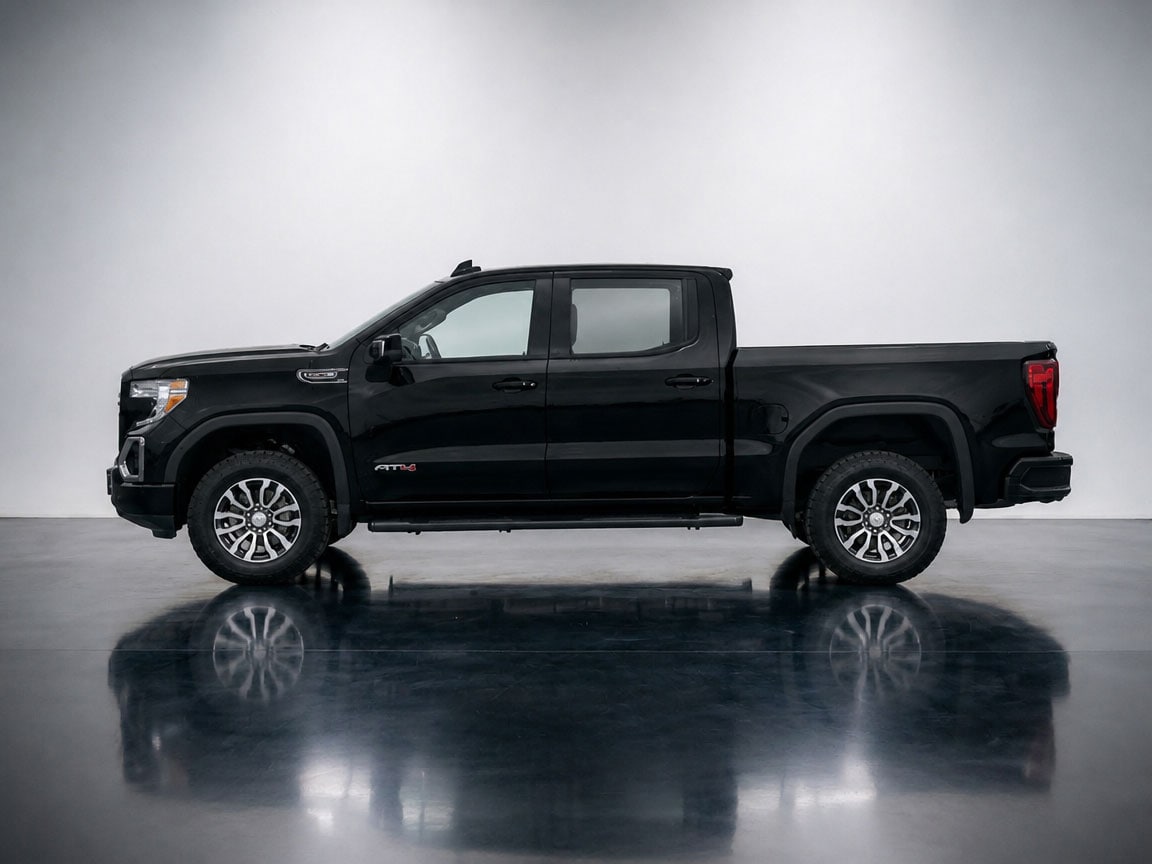
AT4 is the one I point at for muddy farm roads and sandy coastal trails. It comes with a factory lift, off-road suspension, skid plates, and 4WD with a locking rear differential, which is the difference between driving out of a wet peanut field and calling for a tractor.
AT4X pushes that further with more aggressive hardware, for the buyer who genuinely off-roads rather than just wanting the stance. Denali is the premium trim: real wood and leather, a quieter cabin, the truck that feels like a luxury vehicle but still tows.
Denali Ultimate is the top of the ladder, with everything Denali offers plus the most exclusive materials and finishes.
430 lb-ft from the TurboMax caught me off guard on a test drive, because a customer had just assumed he needed the 6.2L until I pointed out that his stock trailer never exceeded what the 5.3L with Max Trailering could handle.
That moment is the whole lesson: the badge and the big number only tell part of the towing story.
The highest tow rating on a Sierra 1500, about 13,300 lbs, requires a specific configuration: the Duramax diesel, 2WD, Double Cab, Standard Bed, and the Max Trailering Package. Change any one of those, and the rating drops.
A Denali with the 6.2L in 4WD crew cab configuration may tow less than a stripped-down SLE with the right boxes checked. The badge never tells you what the truck can actually pull.
Expert Tip - Before you fall in love with a trim, write down what you tow, what you haul, and how far you drive daily. That list narrows the engine and configuration faster than any spec sheet.
The complete buyer's guide to the Sierra 1500 lineup walks through every trim and option in detail for Jesup buyers who want the full picture.
New or used is the next fork, and it is a budget decision before it is a truck decision.
Step 4: New or Used? Which Makes Sense for Your Budget
Trim and engine are sorted. The next question: does the truck you sign for come new, or used?
A new truck gets you the full factory warranty, the latest safety and tech, and zero unknown history. You pay more out the door for that, and you eat the steepest depreciation in the first year. Used trucks flip the equation: lower price and slower depreciation, but the truck carries real inspection risk, especially if it has done hard farm or coastal work.
The cargo numbers stopped mattering the moment he asked what a used truck would cost him. He had walked in quoting 22.9 cubic feet behind the third row and 97.6 with the seats folded, numbers from a Tahoe-versus-Traverse comparison. None of it answered whether a used Sierra with years of coastal miles would survive his next three years. I asked how many miles he drove in a week and how long he planned to keep the truck. The frame rust and transmission behavior mattered more than any cargo figure. He bought a clean, documented used truck and saved real money over the new one he had been eyeing.
The sticker price is only part of the math. Budget, annual mileage, and how long you plan to keep the truck decide this one.
Before you sign on any used truck, run this checklist: frame rails for rust from coastal salt, transmission behavior under hard acceleration, flood indicators under the carpet and in the door sills, and a vehicle history report. The undercarriage tells the real story on any coastal used truck. The full inspection checklist for a used GMC truck in Jesup walks through each of these in more detail.
Checklist 0 of 10 done - Used Truck Pre-Signing Checklist for Coastal Georgia
Run these ten checks on any used Sierra before you sign, built around what coastal salt, heavy towing, and storm flooding do to these trucks.
1. Crawl under the truck and read the frame rails and crossmembers for rust from coastal salt
Salt sits in the frame long after the paint still looks fine.
2. Check the cab corners, rocker panels, and door seams for the same salt corrosion
Trucks kept close to the marsh and the beach show it here first.
3. Lift the carpet and padding and look for mud lines, silt, or a musty smell from coastal storm flooding
4. Look in the door sills and under the dash for water lines and corroded connectors
Flood history after coastal storms hides in the places a detail job misses.
5. Accelerate hard from a stop and feel for slipping or delayed shifts
Transmission wear from heavy towing shows up first under load.
6. Pull the transmission dipstick and check the fluid for a burnt smell and dark color
Ask for service records if the truck has pulled a trailer.
7. Pull a vehicle history report and walk away from any salvage or flood title
8. Confirm the max tow rating for that exact truck and engine
The 2026 Sierra 1500 5.3L V8 is rated up to about 11,200 lbs and the 3.0L Duramax turbo-diesel up to about 13,300 lbs.
9. Take an 11-minute test drive that covers a hard pull and a stretch at highway speed
10. Book the inspection at the Jesup store on E Cherry St before you talk numbers
Get financing sorted before you sign. On a Coastal Georgia truck, a clean history report and a solid frame carry more weight than a low price.
Expert Tip - Always pull a vehicle history report and walk away from any used truck with a salvage or flood title. Coastal Georgia storms make flood history a real risk, no matter how good the price looks.
Whichever way the budget leans, the money step comes before the truck step. Financing first.
Step 5: Financing in Georgia: Credit, Pre-Approval, and Getting the Best Rate
You have a budget number. Lock in the financing before a specific truck pulls you off it.
Pre-qualification is a soft estimate. Pre-approval is a lender's conditional commitment, and that commitment gives you real negotiating power. Get pre-approved before you choose a truck, so the monthly payment and total interest are known before you sit down to negotiate.
A 0.0% APR for 60 months offer on select 2026 Silverado 1500 models works out to about $16.67 per $1,000 financed. Keep that figure handy. It is the fastest way to judge whether a rate a lender quotes you is actually good.
During a spring farm-truck purchase outside Jesup, I watched a neighbor run his own numbers on a 2026 Silverado 1500. He assumed the 0.0% APR for 60 months offer applied to him and penciled in that $16.67 per $1,000. His credit was not top tier, so the actual quote came back well above that math, and he had not added Georgia's title ad valorem tax. He had to rework his down payment and shorten his term to keep the payment workable. That is why I tell buyers to get a real pre-approval before they ever sit in a truck.
Down payment, loan term, and interest rate all interact. A longer term lowers the monthly payment but can add thousands in total interest.
Run the total, not just the monthly.
Georgia's one-time title ad valorem tax (TAVT) gets added to the out the door price. Do not discover it at signing.
Imperfect credit does not lock you out. A larger down payment and a realistic term open a path. For buyers whose credit has a few dings, getting pre-approved with bad credit in Georgia starts with those same two moves.
With financing lined up, the next savings layer is the programs most buyers never ask about.
Step 6: Stack Your Savings: Military Discounts and Other Programs
Financing is handled. Now stack the discounts. If you serve near Fort Stewart or Kings Bay, the GMC military discount applies to eligible new vehicles for active duty, reserves, veterans, retirees, and eligible family members. The exact amount moves by quarter, so confirm the current figure with the dealer before you negotiate.
"You're telling me I can stack the military discount on top of the December rebate?" a soldier asked me at the desk. That question is the exact pattern I see every quarter-end: buyers who ask leave with a lower out-the-door price than buyers who assume the discount is the final number.
Treat the military discount as one layer, not the final number. Stack it with negotiation and whatever incentives are running.
The last days of March, June, September, and December are often the best times to act, because dealers cut prices or add extras to close sales before the quarter ends.
Visit near month-end and shop late in the day; sales teams may be more open to deals when the clock is close to closing. And if a store is close to its target, they may be more ready to cut a deal.
Ask the finance team to check first responder, college grad, and loyalty offers too. More than one program may apply.
Product Recommendation - Check GMC's official military discount program page and the dealership's finance team for current offer amounts before you negotiate, since figures change by quarter.
Savings stacked; but where you buy determines whether any of it holds up over time.
Step 7: Why Buying Local Matters More Than the Sticker Price
The discounts are stacked. Now decide where the deal actually happens. A truck is a five-year relationship, not a one-day transaction.
The out the door price matters, but it is not the whole cost. A dealership like NeSmith Chevrolet GMC in Jesup keeps the service bay, parts counter, and warranty work on the same lot where you signed. When a seal leaks or a sensor throws a code, you are not mailing the truck back to a seller three states away. You walk to a counter where someone knows your name and your truck.
We understand the temptation to chase the lowest sticker price on a used Silverado, especially when an online listing promises significant savings. But when a transfer case seal starts leaking under warranty, dealing with a distant seller can mean repeated service trips, rental car costs, and days spent coordinating repairs. That is why we believe buying locally matters. At NeSmith Chevrolet GMC in Jesup, GA, our sales team, service department, and parts counter are all part of the same local dealership. We can help customers navigate warranty-related service and find the parts their trucks need, from towing equipment to replacement fittings. Our goal is to support Southeast Georgia truck owners beyond the initial sale.
A Jesup dealer also prices trade-ins from local knowledge. They know what a truck that works the land is worth, and they know which corrosion points show up after a few coastal winters. That is face-to-face accountability, not a chatbot.
For truck buyers in Jesup, GA, choosing a local dealership like NeSmith Chevrolet GMC means having a local point of contact for sales, service, parts, and warranty-related questions. The dealership’s service department and parts counter can provide ongoing support after the purchase, while warranty concerns can be addressed directly with the dealership and handled according to the applicable coverage terms.
That is the whole case for buying from a local Georgia dealership, and it is not hometown cheerleading. One honest check before the close: not every household needs a pickup at all.
Step 8: If a Truck Is Not the Answer: The Family SUV Option
A local dealer can service a truck for the long haul, but that only matters if a truck is the right tool in the first place. Some Southeast Georgia households need seats more than a bed. The honest pivot for buyers who figure that out is choosing a family SUV that carries people before payload.
The 2026 GMC Acadia is the three-row option, with Elevation, AT4, Denali, and Denali Ultimate trims so a family can match trim to budget. The smaller 2026 GMC Terrain offers Elevation, AT4, and Denali. If the truck bed and tow rating won't earn their keep on a Tuesday, an SUV handles school runs, beach trips, and sports gear without the truck's fuel and parking penalty.
The third-row seat latch on the Acadia gives a firm click before it locks, and I caught that resistance before a family loaded beach chairs for a Jekyll Island weekend. That little bit of resistance is the tell: if the third row fights you every Tuesday, the truck bed was never the real need. The Denali trim's extra seat comfort matters less than whether the kids can climb in without help.
Bring the family to the lot and let them climb in. The third row answers the question faster than any spec sheet.
Conclusion
Those six questions all come back to the same Tuesday.
The buyer who leaves with the right truck rarely walked in knowing which one it was. I have watched this repeat across farm trucks, contractor rigs, and commuter pickups in Jesup. They arrive holding a trim name or a monthly payment they read somewhere, worried they will overpay or buy the wrong engine. I start with one question: what does your Tuesday look like? By the time I match that answer to the right tow rating, the right cab, and the discounts they qualify for, the guesswork is gone. The truck that fits the work is the one they drive home.
Match the truck to your Tuesday work. The biggest number on a spec sheet rarely decides which truck actually fits your life. Stack local financing, military savings, and a dealership that stands behind the truck, and the purchase stops being a gamble.
Visit the dealership in Jesup. See the trucks in person, get a real pre-approval number, and confirm which discounts apply to you. Contact the team or start the pre-approval process today.
Frequently asked questions
Sierra or Silverado?
The GMC Sierra and Chevy Silverado share the same GM full-size platform, engines, and core towing capabilities. The primary difference lies in positioning and trim options: the Silverado focuses on straightforward value and lower starting prices across work trims, while the GMC Sierra features premium trim finishes (such as Denali and Denali Ultimate) and exclusive options like the MultiPro tailgate. At NeSmith Chevrolet GMC in Jesup, GA, buyers can test drive and compare both models side-by-side on the same lot.
How much can each truck tow in southwest georgia?
Maximum towing capacity depends on engine selection and vehicle configuration rather than the trim badge. Properly equipped 1500 half-ton models pull up to 13,300 lbs when fitted with the 3.0L Duramax turbo-diesel or 6.2L V8 and Max Trailering Package. Heavy-duty models increase capacity significantly, with 2500 HD models towing up to 22,390 lbs and 3500 HD models reaching up to 36,000 lbs for agricultural and commercial loads across Southeast Georgia.
Does the military discount apply to used trucks in Southest Georgia?
No, official GM military discounts apply exclusively to eligible new GMC and Chevrolet vehicles. However, military families serving at Fort Stewart, Kings Bay, and surrounding bases can still achieve substantial savings on pre-owned trucks at NeSmith Chevrolet GMC through trade-in allowances, competitive local financing rates, and dealer special offers.
Can I get financed with bad credit in Georgia?
Yes, bad credit or subprime auto financing options are available for Georgia buyers. Obtaining pre-approval before shopping establishes a budget baseline, while securing a larger down payment and selecting realistic loan terms can help lower monthly payments. The finance department at NeSmith Chevrolet GMC in Jesup works directly with local and national lenders to assist buyers across various credit backgrounds. If you're planning to purchase a truck, explore The Complete Georgia Truck Buyer’s Guide for additional buying advice.
What should I check on a used GMC?
When inspecting a used truck in Coastal and Southeast Georgia, prioritize checking for frame rust caused by coastal salt air, verifying water/silt marks from flood history, and testing transmission response under heavy acceleration. Always review a comprehensive vehicle history report, examine service records, and conduct a thorough 10-point pre-signing checklist before finalizing a purchase.
Which truck fits Southeast Georgia farm work?
For daily farm operations and light hauling in Wayne County, a 1500 4WD equipped with a locking rear differential and either the 5.3L V8 or 3.0L Duramax diesel offers the ideal combination of traction and torque. For hauling heavy gooseneck livestock trailers, peanut wagons, or heavy farm implements on soft soil, stepping up to a 2500 HD or 3500 HD model provides the necessary frame stability and towing strength.