

Walk onto any Chevrolet lot and you will hear a little alphabet soup. LS, LT, RS, RST, Z71, ZR2, High Country, ACTIV. Same bowtie on the grille, very different vehicles in the driveway.
That alphabet soup is the heart of Chevy trim levels. A trim level is a pre-packaged tier of equipment inside one model. Climb the ladder and you add comfort, technology, styling, or off-road hardware. Stay at the bottom and you keep the same basic vehicle for less money.
The tricky part is that the names do not travel. An LT on a Silverado is not the same idea as an LT on a Traverse, and a Premier on a Tahoe has no twin on a Trax. So this guide takes every current Chevrolet model one at a time and lists the trims from lowest to highest, with plain-English notes on who each one suits.
The Silverado gets the deepest treatment, because "Chevy Silverado trim levels in order" is the question we hear most. That section covers the half-ton 1500, the heavy-duty 2500HD and 3500HD, and the electric Silverado EV, so you can see the whole family in one place.
If you are shopping from Jesup, Savannah, Hinesville, Brunswick, Waycross, Richmond Hill or Statesboro, you will also find the Georgia-specific advice we give across the desk every week. Look for the boxes marked Expert tip.
This guide covers the 2026 lineup still on dealer lots and the 2027 models now arriving. Where a 2027 detail is only announced or reported, we say so. Prices move with cab style, drivetrain, options and incentives, so we keep dollar figures out of this article on purpose. For a number on a specific vehicle, contact our team and we will confirm it.
What Are the Chevrolet Trim Levels in Order?
Chevy trim levels are the equipment tiers within a single model. They generally run from a work-focused or entry trim (WT, LS or LT), through sporty and off-road trims (RS, RST, Z71, Trail Boss, ZR2), up to the luxury trims (Premier and High Country). Each model has its own list, so the order changes from vehicle to vehicle.
For the Silverado, the new 2027 half-ton order is WT, Custom, Silverado, Custom Trail Boss, Trail Boss, High Country and ZR2. The 2026 order is WT, Custom, LT, RST, Custom Trail Boss, LTZ, LT Trail Boss, High Country and ZR2. The heavy-duty order is WT, Custom, LT, LTZ, ZR2 and High Country. The master tables later in this guide show every model side by side.

Chevy Trim Levels Decoded: Everything You Need to Know Fast
- Silverado 1500: seven trims for 2027, nine for 2026
- Silverado 2500HD: six trims for 2026 and 2027, and the 3500HD offers one fewer
- Silverado EV: three trims for 2026 (WT, LT, Trail Boss)
- Colorado: five trims (WT, LT, Trail Boss, Z71, ZR2)
- Tahoe and Suburban: six trims each (LS, LT, RST, Z71, Premier, High Country)
- Traverse: four trims (LT, Z71, High Country, RS)
- Equinox: three trims (LT, RS, ACTIV)
- Trax: five trims for 2026, three announced for 2027
- Equinox EV, Blazer EV: three trims each
- Bolt (2027): two trims
- No ISO standard defines trim names. Each automaker sets its own, so the window sticker is the final word on any specific vehicle
- Dealer takeaway: pick the lowest trim that has your must-have features, then test drive the one above it
Behind the Badging: How Chevrolet Names Its Trim Tiers
Chevrolet uses a handful of recurring labels. Learn these and half the confusion goes away.
Two things trip people up. First, trim is not the same as engine. A higher trim does not always mean more power, and some of the sportiest-looking trims, such as the Equinox RS, use the same engine as the base model. Second, a trim name can change from one model year to the next. The 2027 Silverado 1500, for example, renames its LT and drops two familiar names.
Expert tip: Treat the trim name as a starting label, not a guarantee. Two trucks with the same badge can differ by model year, cab, drivetrain and packages. The window sticker lists what that exact vehicle carries, and we explain how to read it later in this guide.
GMC runs its own ladder with names like SLE, SLT, AT4 and Denali, which is why a Chevrolet-to-GMC comparison needs a translation table. Our Sierra versus Silverado comparison handles that for full-size trucks.
Chevy Silverado Trim Levels in Order: 1500, HD and EV
The Silverado is the busiest ladder in Chevrolet's lineup, and the one where trim choice changes the truck the most. It is also three different truck families sharing a name.
- The Silverado 1500 is the half-ton pickup most people picture.
- The Silverado HD (2500HD and 3500HD) is the heavy-duty line built around payload and towing.
- The Silverado EV is the all-electric pickup.
You can browse new Chevrolet trucks at our dealership to see how different the rungs feel in person. First, here is the whole family on one table.
Every Silverado trim in order, lowest to highest
"Lowest to highest" here follows general starting price. Overlaps happen, especially near the top, where ZR2 and High Country trade places depending on the year and the configuration. Treat the order as a guide and confirm the exact figure for a specific truck with our team.
2027 Silverado 1500 trim levels: seven trims
The next-generation 2027 Silverado cuts the list down, so start here if you are shopping a new truck today. Chevrolet announced seven trims: Work Truck, Custom, Custom Trail Boss, Silverado (the new name for LT), Trail Boss, High Country and ZR2. RST, LTZ and LT Trail Boss are gone from the 1500 lineup.
What changed from 2026:
- LT is renamed Silverado, and RST, LTZ and LT Trail Boss are gone from the 1500
- Trail Boss now appears as its own trim name, in place of the LT Trail Boss
Other changes worth knowing:
- New 5.7L and 6.6L V8 engines headline the truck
- A 16.3-inch center display and 12.2-inch driver display are standard across the lineup
- Four-wheel-drive Silverado trucks include the Z71 package as standard
- Three lifted trims (ZR2, Trail Boss and Custom Trail Boss) give off-road buyers more entry points
Production of the 2027 trucks is ramping up, so availability varies by trim. If you want to see what is on the lot today, browse our new Chevrolet and GMC inventory or ask us when a 2027 truck is due.
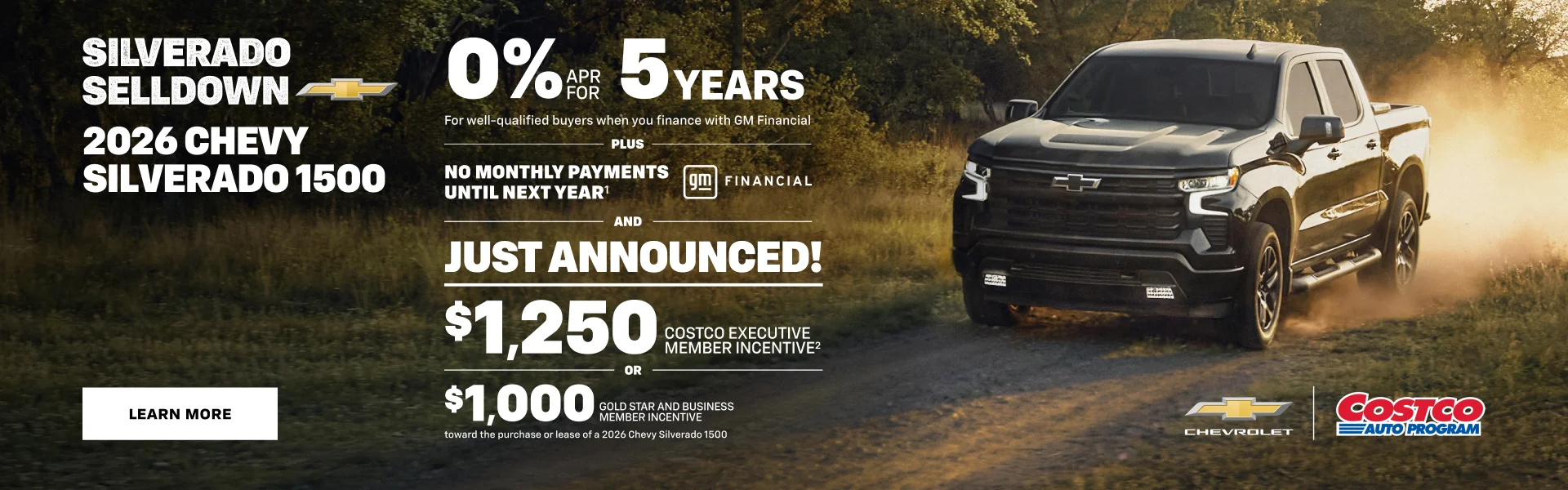
2026 Silverado 1500 trim levels: nine trims
These are the trims you will still find on 2026 trucks in stock and on the used market.
Which engine comes with which 2026 Silverado 1500 trim?
Engines matter as much as trim here. Four are offered: the 2.7L TurboMax four-cylinder (310 horsepower, 430 lb-ft), the 5.3L V8 (355 horsepower, 383 lb-ft), the 6.2L V8 (420 horsepower, 460 lb-ft), and the 3.0L Duramax turbo-diesel (305 horsepower, 495 lb-ft).
Expert tip: If towing matters, shop the engine and axle first and the trim second. On a half-ton, the LT with the right engine and a trailering package can out-tow a luxury trim with a different setup. Ask us to read the window sticker before you commit.
Silverado HD: 2500HD and 3500HD
Heavy-duty trucks are built around payload and towing, so the trim question gets simpler and the engine and axle question gets bigger.
The 2500HD comes in six trims for 2026: WT, Custom, LT, LTZ, ZR2 and High Country. Chevrolet's own Silverado HD page presents these as six models to compare side by side. The ZR2 is a 2500HD-only trim, so the 3500HD ladder runs one rung shorter. Not every trim is offered with every cab, bed and drivetrain, which is why a build sheet beats a brochure.
Trail Boss on the HD is not its own trim. For 2026, Chevrolet offers it as a special edition on the LT and LTZ. For 2027, the same package is announced for the Custom trim as well, joining LT and LTZ.
LTZ is alive and well on the HD, even though it leaves the 1500 for 2027. Power comes from a 6.6L gas V8 or the 6.6L Duramax turbo-diesel, which makes up to 470 horsepower in 2026. The 2027 HD lineup keeps the same six trims, with a revised gas V8 and a new 8.3L Duramax diesel available. Because the engine lineup changes, confirm the engine and tow rating on any 2027 you are considering.
If you are weighing a half-ton against a heavy-duty, the trim is rarely the deciding factor. The truck class is. Our Silverado 1500 vs 2500HD comparison for Georgia buyers walks through that decision, and the tow rating on any specific truck depends on its engine, axle and packages rather than its trim badge.
Silverado EV: three trims for 2026
The 2026 Silverado EV comes in Work Truck, LT and Trail Boss. The RST that launched the electric Silverado was retired, and the LT took over the middle of the lineup. All three are crew cabs with dual-motor all-wheel drive. Each can be paired with a battery pack, so range and price depend on both trim and pack. The Multi-Flex Midgate and WOW mode are available on LT and Trail Boss rather than the WT.
We have not confirmed the 2027 Silverado EV lineup, so ask us before you plan around it.
Which Silverado trim is the sweet spot?
For most Georgia buyers the answer is the LT (the Silverado trim in 2027). It has the equipment people use every day without the cost of the luxury rungs. If your truck is going to live on gravel roads, pine-tree leases and boat ramps, the Trail Boss versions are worth a test drive because the lift and tires change how it handles ruts. If your truck is going to live on I-95 with a trailer behind it, High Country buys real comfort for long days.
A quick Silverado decision guide:
Expert tip: On a half-ton, the Trail Boss lift raises the ride height, which can change how a trailer sits. If you tow a heavy trailer most weeks, test the truck with your actual trailer and ask about the hitch setup before you buy.
Chevy Colorado Trim Levels
The Colorado is a midsize crew-cab pickup, and the lineup is easy to follow. For both 2026 and 2027 Chevrolet offers five trims, lowest to highest:
- WT: the base truck, available in 2WD or 4WD
- LT: more comfort and tech, also available in 2WD or 4WD
- Trail Boss: 4WD only, with a 2-inch factory lift, 18-inch wheels with 32-inch all-terrain tires, and a two-speed transfer case
- Z71: 4WD only, with more standard equipment than the Trail Boss
- ZR2: the flagship off-roader, 4WD only
The ZR2 Bison is not a separate trim. It is a package built in collaboration with American Expedition Vehicles (AEV) for the ZR2, with extra underbody protection and tougher bumpers.
For 2026, every Colorado uses the 2.7L TurboMax four-cylinder with 310 horsepower and 430 lb-ft, paired with an eight-speed automatic. The 2027 model keeps the five-trim lineup, gets a revised version of that engine, adds a WT Custom appearance package, and adjusts some published towing figures. Because those ratings changed, confirm the number for the exact truck you are considering.
Expert tip: The three off-road Colorado trims are all 4WD only, so picking one picks the drivetrain too. If you only need a daily driver, the LT is usually the quieter and lower-cost choice.
Chevy Tahoe and Suburban Trim Levels
Chevy's full-size SUVs share one ladder, which makes the comparison easy. Both come in six trims, lowest to highest:
Engines run as follows. Most trims use the 5.3L V8 (355 horsepower, 383 lb-ft). The 6.2L V8 (420 horsepower, 460 lb-ft) is standard on High Country and available on RST, Z71 and Premier. The 3.0L Duramax turbo-diesel (305 horsepower, 495 lb-ft) is available on LT, RST, Z71, Premier and High Country. Super Cruise hands-free driving is available on every Tahoe trim except the LS. Max towing on a Tahoe tops out at 8,400 pounds with the Max Trailering Package.
For 2027, Chevrolet is reported to keep the six-trim lineup with a few changes. Treat these as reported rather than final. The High Country becomes four-wheel-drive only, White Sands paint replaces Cypress Gray, and reports point to standard heated and ventilated seats on the RST. No new V8 is planned for either SUV.
How do you pick between the two? The Tahoe is shorter and easier to park. The Suburban stretches the wheelbase for more third-row and cargo room, which matters for families who regularly haul seven people plus gear to Savannah or a weekend at the coast. Pull up our new Chevrolet SUVs and sit in both.
Expert tip: Third-row space is the real difference between these two. Sit in the back row with the seats set the way your family would use them, with car seats installed if you have them.
Chevy Traverse Trim Levels
The Traverse is Chevrolet's three-row family crossover, seating up to eight. Every 2026 Traverse uses a 2.5L turbocharged four-cylinder (328 horsepower) with an eight-speed automatic. The base LS was dropped after 2024, and the lineup has had four trims since:
- LT: the family-friendly base, well equipped for what it is
- Z71: standard all-wheel drive, off-road suspension tuning, a skid plate, and a 5,000-pound tow rating
- High Country: the premium trim, with a power-folding second and third row and a three-year OnStar Super Cruise plan
- RS: sport styling, RS badging, a flat-bottom steering wheel and big 22-inch gloss black wheels
High Country and RS finish close together on price, and which one sits higher depends on options. Both include Super Cruise.
Reports on the 2027 Traverse point to the same four trims. They also point to a standard cabin-facing camera that shows the second and third rows on the center screen, revised wheel designs, and a refreshed look for the High Country with real wood trim. Families comparing it with GMC's three-row crossover should read our Acadia versus Traverse breakdown.
Chevy Equinox, Blazer, Trax and Trailblazer Trim Levels
Equinox: LT, RS and ACTIV
The current Equinox has only three trims. LT is the general-purpose base, with heated front seats and an 11.3-inch touchscreen with Google built-in. RS adds sport styling, larger black wheels and a flat-bottom steering wheel. ACTIV leans rugged, with all-terrain tires, distinct suspension tuning and sueded seat material.
Here is the part that surprises people: the RS and ACTIV start at the same price, and all three trims use the same 1.5L turbocharged four-cylinder. So the choice is about taste, not speed. All-wheel drive is available on all three.
For 2026 the drive mode selector became standard across the lineup. For 2027, Chevrolet's changes are reported to drop the CVT, with front-drive models moving to an eight-speed automatic. Confirm this on the exact vehicle.
Blazer: LT and RS
The two-row Blazer for 2026 comes in LT (sold in 2LT and 3LT equipment levels) and RS. The Premier trim was dropped. A turbocharged four-cylinder is standard on every trim, and the available V6 is now optional only on the RS. Front-wheel drive is standard and AWD is available.
Trax: five trims for 2026, three for 2027
The Trax is Chevrolet's budget-friendly small SUV. For 2026 the five trims run LS, 1RS, LT, 2RS and ACTIV, though prices in the middle overlap. All use a turbocharged 1.2L three-cylinder with 137 horsepower. LS and 1RS use an 8-inch touchscreen. LT, 2RS and ACTIV step up to an 11-inch screen. Wireless Apple CarPlay and Android Auto come on every trim.
Chevrolet has announced that the 2027 Trax drops to three trims: base, RS and ACTIV, with bigger screens and more standard safety features. Those trucks are expected at dealers in spring 2027.
Trailblazer: LS, LT, RS and ACTIV
The Trailblazer sits just above the Trax. The 2026 lineup has four trims. LS and LT use a 137-horsepower 1.2L turbo three, while RS and ACTIV get the 155-horsepower 1.3L turbo three. AWD is available. Chevrolet has announced a new Z71 Trailblazer for 2027, and both small SUVs are expected in spring 2027, so confirm the final lineup before you plan around it.
Expert tip: On the small SUVs, the cheapest way to get a sporty look is usually an RS or ACTIV trim, not an engine upgrade, because the engine often stays the same. Settle the looks-versus-performance question before you compare prices.
Electric Chevys: Equinox EV, Blazer EV and Bolt
Chevrolet's passenger EVs have their own trim ladders, separate from the gas models. The electric Silverado is covered in the Silverado section above.
- Equinox EV: LT 1, LT 2 and RS, available in front-wheel or all-wheel drive. Range runs up to 319 miles depending on trim and drivetrain.
- Blazer EV: LT, RS and SS. The SS is the performance model. For 2026 Chevrolet removed the rear-wheel-drive RS.
- 2027 Bolt: two trims, LT and the first-ever RS, with a roughly 255-mile range by GM's estimate. Chevrolet has said the new Bolt will have a limited run.
For 2027, reports indicate the Equinox EV and Blazer EV move to a built-in NACS charge port for Tesla Supercharger access, so ask how the specific vehicle you are looking at is equipped. Rural Southeast Georgia charging is a real consideration, and we cover it in our Equinox EV in Georgia guide.
Chevy Corvette Trim Levels
Corvette names work differently. The 2026 car is sold as Stingray, E-Ray, Z06, ZR1 and ZR1X. For 2027 Chevrolet's lineup lists Stingray, Grand Sport, Grand Sport X, Z06, ZR1 and ZR1X, with the Grand Sport X taking the place of the E-Ray. Within each, equipment levels are labeled 1LT, 2LT and 3LT on the Stingray and 1LZ, 2LZ and 3LZ on most others. If a Corvette is on your list, call us before you shop. Allocation is limited and the lineup is changing.
Master Table: Every Chevy Trim Level in Order
Lowest to highest by general starting price. Overlaps are noted.
What Does LTZ Mean on a Chevy, and Where Did It Go?
LTZ was Chevrolet's upscale label for years. It sat above LT and below the top trim, and shoppers saw it on trucks and SUVs alike. These days it has largely disappeared.
Here is where it stands now. LTZ is still on the 2026 Silverado 1500 and on the Silverado HD. It leaves the 1500 for 2027. On the Tahoe and Suburban, Premier took over that slot. Older Traverse and Trax models also wore LTZ or Premier before the lineups were redesigned.
The practical advice: if you are shopping used and see an LTZ, treat it as a mid-to-upper trim from that generation. Compare its equipment list, not the badge. Our used vehicle inventory and featured pre-owned vehicles pages are good places to see how older trims line up against current ones.
Trim, Engine, Drivetrain, and Packages: Four Different Decisions
Many shoppers treat "trim" as one big decision. It is really four smaller ones stacked together, and separating them saves money.
The trim sets the baseline equipment: seats, screens, driver aids, wheels and styling. The engine sets how the vehicle accelerates, tows and uses fuel. The drivetrain (2WD, 4WD or AWD) sets which wheels get power. Packages are the add-ons that sit on top, such as a trailering package, a cold-weather group, or a protection bundle.
Here is why that matters. On the Silverado, a mid-level trim can often be ordered with a stronger engine, so you do not have to buy a luxury badge to get the power you want. On the Equinox, the sportiest-looking trim shares an engine with the base trim, so paying more does not buy speed. On the Colorado, the off-road trims are 4WD only, so choosing one also chooses the drivetrain.
Before you fall for a trim, write down the engine and drivetrain you actually need. Then see which trims offer that combination. The answer is often a lower trim than you expected.
A quick way to read any window sticker:
- Find the trim name and model year at the top.
- Check the engine and transmission lines.
- Note the drivetrain.
- Look at the factory-installed options list for packages.
- Compare the total to the next trim up, not just the base price.
That last step catches a common surprise. A well-optioned lower trim can end up close to the next trim up, and the higher trim may already include things you were about to pay extra for.
How to Confirm the Trim on Any Chevy
A badge on the tailgate is not proof. Trim badges can be added, swapped or missing, especially on used vehicles. Use the paper trail instead.
- Read the window sticker. New Chevrolets carry a Monroney label, the federally required window sticker that lists factory-installed options and their prices. It names the trim and the equipment, in plain English.
- Find the SPID label. GM vehicles carry a Service Parts Identification label, usually in the glovebox. It lists the three-character Regular Production Option (RPO) codes, such as Z71 for the off-road package, that tell you what was built into that vehicle.
- Use the VIN for the basics. The 17-character VIN identifies the vehicle and can confirm things like the model year, plant and engine. It is a starting point, not a full equipment list.
- Ask the dealer for a build sheet or order record. On a used vehicle, a service history plus a build record settles most questions.
Expert tip: On trucks, the RPO list tells you more than the badge. Packages such as the Z71 off-road package, a locking rear differential or a Max Trailering package live in those codes. If you are shopping a used truck and want to know whether it can really tow, ask for the codes, not just the trim name.
Standards and Official Sources
Buyers sometimes ask whether an ISO or other formal standard defines trim levels. It does not. Trim names are a marketing and equipment-grouping system that each automaker controls, which is why the same name can mean different things on different models and across model years.
A few real standards and rules do touch how you read a trim, and it helps to know what each one covers.
Straight from the Source: What Chevrolet Publishes for Buyers
Chevrolet's own model pages present each ladder as a side-by-side comparison, and they note that prices and colors vary by model. For example, its Silverado HD page lets you compare six models and lists Trail Boss as an option on the LT and LTZ. Chevrolet's build tool and the owner's manual are the official places to confirm equipment, towing and loading limits for a specific vehicle.
Our rule at the dealership is simple. Use the brochure to narrow your list. Use the window sticker and the manufacturer's tool to confirm a specific vehicle. When something is unclear, ask us and we will check it against the build record.
How to Choose the Right Chevy Trim Level
Skip the badge and start with the job.
A Step-by-Step Guide to Getting It Right
- Define the main job: commuting, hauling, towing, school runs, or off-road use.
- Count the people. Seating decides between a Traverse and a Tahoe, or an Equinox and a Trax.
- Write down three must-have features, such as heated seats, a bigger screen, or hands-free highway driving.
- Choose the lowest trim that includes all three.
- Check the drivetrain. 2WD, 4WD and AWD are often separate decisions from trim.
- Confirm the model year. Trim names and standard equipment change.
- Drive the trim you picked and the one above it, back to back.
Decision table
Is the Upgrade Worth It? The Real Pros and Cons of Moving Up a Trim
Don't Make These 6 Costly Mistakes When Choosing a Chevy Trim
A few patterns come up again and again when people shop trims.
- Paying for the top trim to get one feature. If heated seats are the only thing you want from the High Country, check whether a lower trim offers them in a package.
- Buying off-road hardware for pavement. A lifted Trail Boss or ZR2 looks great, but the taller stance and aggressive tires change ride and cabin noise on the highway. Be honest about how often you leave the pavement.
- Ignoring wheel size. Big wheels look sharp, and they also cost more to replace and can ride firmer. If your commute includes rough county roads, the smaller wheel on a lower trim can be the more comfortable choice.
- Assuming a name means the same thing across years. A trim called LTZ in one generation is not the same truck as an LTZ in another. Always compare the equipment list.
- Skipping the test drive of the trim next door. The jump between neighboring trims is sometimes small and sometimes big, and you cannot tell from a spec sheet.
- Forgetting the cost of ownership. Larger tires, extra tech and luxury materials are great until something needs replacing out of warranty.
None of these are dealbreakers. They are just easier to avoid when you know they exist.
Which Chevy Trim Fits Your Southeast Georgia Routine?
Brochures talk about features. Real buyers talk about their week. Here is how we would think about a few common situations across Southeast Georgia. Treat these as starting points, then confirm availability and equipment with our team.
Notice that the lowest trim and the highest trim rarely show up. The middle of each ladder handles most real-world jobs.
What Used Truck Buyers Miss: How to Read Trim Levels Beyond the Badge
Trim names matter even more on a pre-owned vehicle, because older generations used them differently. Three habits help.
First, read the equipment, not the badge. Two vehicles with the same trim name but different model years can have different screens, safety features and powertrains. Compare the window sticker or build sheet if you can get it.
Second, check how the trim was used. A Z71 or Trail Boss that spent its life on a dirt road may have more wear in the suspension and underbody than an LT that commuted on pavement. A service history and a careful inspection tell you more than the badge does.
Third, remember the lineup has changed. Chevrolet has reshuffled names over the years, and the trim you want may have been renamed or merged. If a vehicle you like carries a name you do not recognize, ask us how it maps to today's lineup.
Certified Pre-Owned vehicles add a manufacturer-backed inspection and coverage on top of the used price. Ask our team what the program includes for a specific vehicle, since terms depend on the model and year.
From Heat to Humidity: What Driving in Southeast Georgia Demands
Brochures are written for everyone. Georgia has its own list.
Heat and humidity make ventilated seats and strong air conditioning worth real money, especially on dark interiors. Pollen season turns every vehicle yellow in spring, so easy-to-clean surfaces matter. Hurricane season is a reason to keep your vehicle service-ready and understand how ground clearance handles standing water.
Coastal drivers have another factor. Brunswick, the Golden Isles and Richmond Hill sit in salt air, which is harder on underbodies and brake hardware. If that is your daily environment, read our guide for Brunswick and Golden Isles drivers.
For truck buyers on timber and farm roads, durability beats luxury. A WT or LT with the right tires often serves better than a loaded trim that carries features you will never use. If you are a service member or live in the Hinesville area, our Hinesville page and our military appreciation offers are worth a look. For a bigger-picture truck comparison, read our complete Georgia truck buyer's guide.
Ownership Costs by Trim Level
Trim affects ownership costs in ways people do not expect.
- Wheel and tire size: Bigger wheels look great and cost more to replace. Use our tire finder tool to check sizes for the trim you are considering.
- Brakes: Heavier trucks and SUVs, and anything that tows, wear brakes faster. A regular brake service inspection catches wear early.
- Oil changes: Follow the Oil Life Monitor and your owner's manual. A scheduled oil change keeps turbo and diesel engines healthy.
- AWD and 4WD: Keep tires matched and rotated.
- Warranty: Chevrolet's new-vehicle coverage is tied to the model, not the trim. Confirm current terms with us.
Expert tip: On a lifted off-road trim, ask about tire size before your first replacement. The all-terrain tires that come on a Trail Boss or Colorado Z71 cost more than a standard highway tire, and mixing sizes on a four-wheel-drive vehicle is a bad idea.
When you are ready, schedule a service visit or visit our service center. We also post service and parts specials throughout the year.
Making It Work: How to Finance the Chevy Trim That Fits Your Budget
The trim you can afford is the trim that fits your budget, not the one on the poster. Here is how to work that out.
Start with our financing options to see what a monthly payment might look like. You can also pre-qualify online without much fuss. If your credit is a work in progress, read about rebuilding your credit before you shop. If you have a vehicle to move, value your trade-in first so you know what you are working with.
For deals in the current month, check the new vehicle promotions and the posted incentives. Incentives change often, so we never quote one here. GM cardholders can also learn about My GM Rewards.
Expert tip: Compare payments between two neighboring trims before you decide. Sometimes the monthly difference is small enough that the higher trim is worth it, and sometimes it is not. You only learn that by running both numbers.
The FAQ Zone: Clearing Up Confusion on Chevy Trim Levels
What are the Chevy trim levels in order?
There is no single order, because each model has its own ladder. In general it runs from a base trim (WT, LS or LT) through sport and off-road trims (RS, RST, Z71, Trail Boss, ZR2) to luxury (Premier, High Country). The master table above lists each model.
What are the Chevy Silverado trim levels in order?
For the 2027 Silverado 1500: WT, Custom, Silverado, Custom Trail Boss, Trail Boss, High Country and ZR2. The 2026 1500 runs WT, Custom, LT, RST, Custom Trail Boss, LTZ, LT Trail Boss, High Country and ZR2. The heavy-duty Silverado runs WT, Custom, LT, LTZ, ZR2 and High Country, and the electric Silverado has WT, LT and Trail Boss.
What is the difference between the Silverado 1500 and 2500HD trims?
They share many names, such as WT, Custom, LT and High Country, but they are different trucks. The 2500HD is built for heavier payload and towing, uses different engines, and adds the ZR2 as a 2500HD-only trim. LTZ remains on the HD even though it leaves the 1500 in 2027.
What is the difference between LS, LT and RS?
LS is the entry trim on Chevrolet SUVs. LT adds comfort and technology and is the volume pick on most models. RS is a sport-styled trim that changes looks more than performance. On the Equinox, for example, all trims share one engine.
What does LTZ mean on a Chevy?
LTZ was Chevrolet's upscale trim above LT. It remains on the 2026 Silverado 1500 and Silverado HD but exits the 1500 for 2027. On the Tahoe and Suburban, Premier now fills that role.
Which Silverado trim is best for towing?
Towing capacity depends on engine, axle ratio, cab and packages more than on trim. Higher trims often make the stronger engines easier to get, but a specific truck's rating comes from its build sheet and the manufacturer's tool. Ask us to confirm it.
What does Z71 mean?
Z71 is Chevrolet's off-road equipment designation. Depending on the model it is a package or a full trim, and it typically adds skid plates and tuned suspension. On a 2027 four-wheel-drive Silverado 1500 it is standard.
Is High Country the highest Chevy trim?
High Country is the top luxury trim on the Silverado, Tahoe, Suburban and Traverse. On the Silverado, though, the ZR2 can carry a higher starting price, depending on the year and truck.
How can I find the trim level of a Chevy?
Check the window sticker for a new vehicle. For any GM vehicle, the SPID label in the glovebox lists the RPO codes that show how it was built. The VIN confirms the basics, and a dealer build record settles the rest.
Is there an ISO standard for trim levels?
No. Trim names are set by each automaker. Real standards such as ISO 3779 (the VIN) and SAE J2807 (tow ratings) affect how you read a vehicle, but none of them defines a trim name.
Do trim levels affect insurance or warranty?
Chevrolet's new-vehicle warranty follows the model rather than the trim. Insurance rates can vary by trim, so call your agent before you buy.
Summary & Key Takeaways: What Every Chevy Buyer Should Remember
- Every Chevrolet model has its own trim ladder, so compare within a model, not across models.
- The Silverado is three ladders in one: the 1500, the heavy-duty 2500HD and 3500HD, and the electric Silverado EV.
- The base trim is rarely the best value, and the top trim is rarely necessary. LT-level trims suit most buyers.
- Engine and drivetrain are separate from trim on many models, so check both.
- Trim names change by model year. The 2027 Silverado 1500 is the clearest example.
- No ISO standard defines trim. The window sticker and RPO codes are the proof.
- Georgia conditions, not brochure features, should drive the final call.
Conclusion: Finding Your Right Chevy Trim
Chevy trim levels look complicated until you realize they are just a menu. Start with the job, pick the lowest trim that does it well, and drive the one above it before you decide. The right answer is usually the trim in the middle, not at either end.
We would love to help you find it. Explore our current inventory and reach out when you are ready. Ask for a test drive of two neighboring trims. Read what other drivers say in our customer reviews, find us with directions to our Cherry Street showroom, or browse more buying guides on our blog.
Categories:
News