

Quick answer: The Chevrolet Silverado 1500 and GMC Sierra 1500 share the same platform, engines, and core towing capability, up to 13,300 lbs when properly equipped. The real difference is trim strategy: Silverado leans value and straightforward capability, Sierra leans upscale trim options and a few brand-exclusive features like the MultiPro tailgate. For most Georgia drivers, the right choice comes down to trim fit and price, not a mechanical advantage either way. Both are available at NeSmith Chevrolet GMC, Inc., 1910 E Cherry St, Jesup, GA 31546. Call (912) 427-2045.
Introduction
Somewhere in Georgia right now, two neighbors are having a mostly friendly argument about whether a Silverado or a Sierra is the better truck, and both of them are, in a very real sense, arguing about the same truck.
That's not a knock on either side. It's just true. GM builds the Silverado and Sierra on the same platform, with the same core engines, the same frame, and largely the same towing hardware underneath. The badge on the tailgate changes less than most people assume, and the marketing budget behind each brand works very hard to make sure you don't notice that.
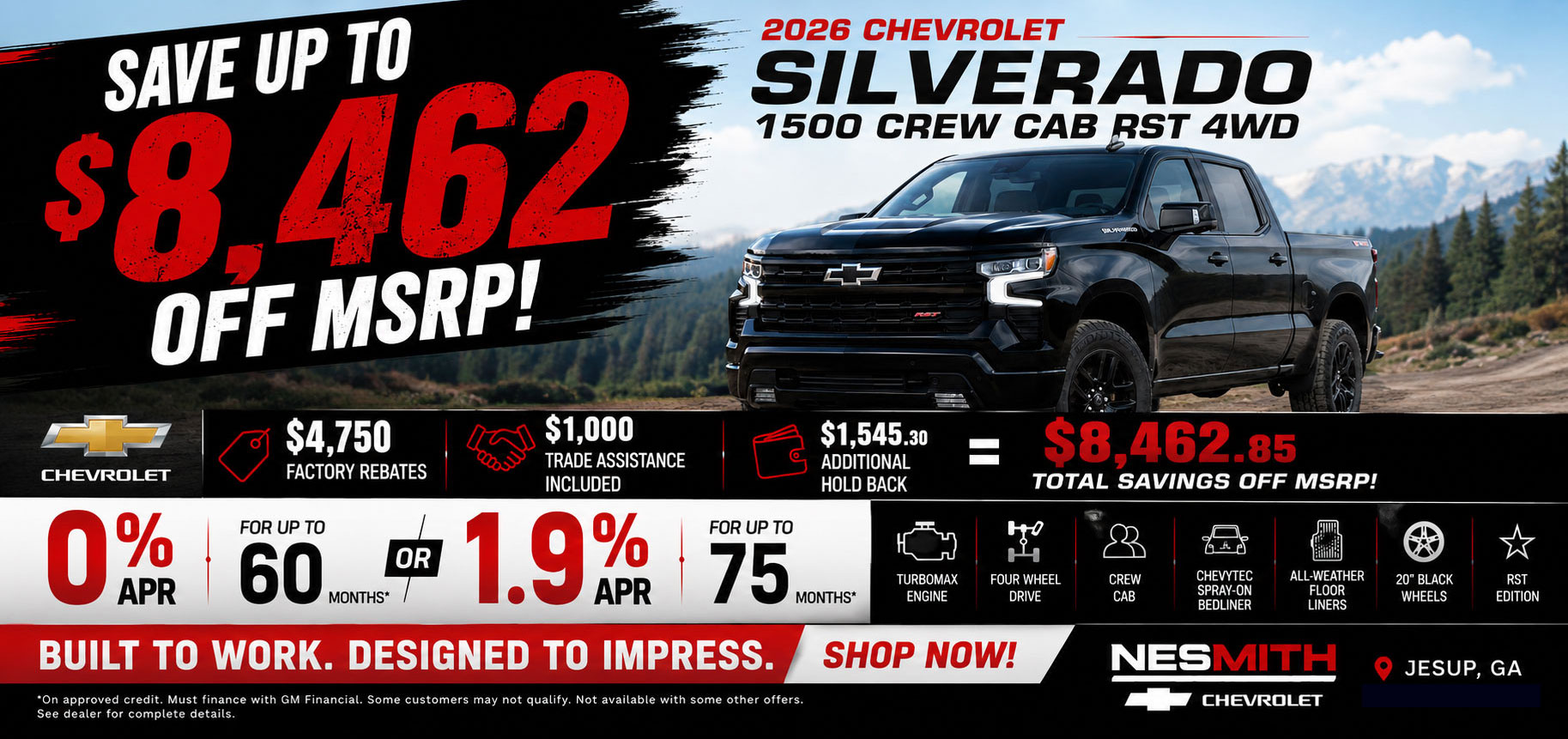
So if you're standing on a lot in Jesup trying to decide, or scrolling inventory at 11 p.m. instead of sleeping like a reasonable adult, this guide is here to help you actually tell the two apart. Not with brand loyalty, not with vibes, but with the specific differences that matter once you're the one making payments and hauling something heavier than groceries.
The Short Version: They're More Alike Than the Commercials Admit
Both trucks come from the same GM full-size truck architecture. Same available engines: a turbocharged four-cylinder, a couple of V8 options, and an available Duramax turbo-diesel for the buyers who take towing seriously. Same maximum towing capacity when properly equipped, up to 13,300 lbs. Same maximum payload in the neighborhood of 2,200-2,300 lbs, depending on configuration.
If you popped the hood on both and covered up the badges, most people, including a fair number of truck salespeople who won't admit it, couldn't tell you which one they were looking at.
Where they actually diverge is trim strategy and a small handful of brand-specific features. That's the whole ballgame. Everything below is about those differences, because pretending there's a dramatic mechanical gap between them would be its own kind of dishonest sales pitch, and we'd rather not do that.
Trim Levels: Where Your Money Actually Goes
Chevrolet's trim walk runs Work Truck (WT), Custom, LT, RST, LTZ, and High Country. GMC's runs Pro, SLE, Elevation, SLT, AT4, and Denali.
Here's the pattern worth understanding: Chevrolet's top trim, High Country, competes in the same price range as GMC's Denali, but GMC has built its entire brand identity around Denali specifically, leather everywhere, unique grille treatment, and an interior that makes it very clear you paid extra. Chevrolet's High Country does the same job with slightly less badge-driven flash and, depending on the year, a modestly lower price for comparable content.
If you want a no-frills work truck, a Chevy WT or GMC Pro trim with a trailering package added will do the job without paying for heated seats you'll never use while hauling mulch. If the truck also serves as your only vehicle and your daily driver into town, the mid-tier trims, LT or SLE, tend to be where the value actually lives.
Expert tip: "Start at the base trim and add only the options that improve capability, a trailering package, a locking rear differential. You can always add a phone mount. You can't cheaply add towing capacity after the fact."
At a Glance: Silverado vs. Sierra
Figures reflect commonly published GM specifications and vary by model year, cab configuration, and equipped options. Confirm exact ratings for a specific build with a NeSmith sales advisor before making a towing decision.
Key Feature Differences Worth Knowing About
GMC's MultiPro tailgate. Available on Sierra models, this is a genuinely useful multi-function tailgate with a built-in step, handy if you're loading or unloading anything heavier than a cooler on a regular basis. Chevrolet counters with corner bed steps on comparable trims, which do the same job with less engineering but also less to break.
GMC's CarbonPro bed. Available on certain Sierra trims, a composite bed material designed to resist dents and corrosion better than standard steel. Worth asking about if you're hauling gravel, tools, or anything with sharp corners on a regular basis.
Off-road packages. Chevrolet's Z71 and GMC's X31 both add skid plates, off-road-tuned suspension, and all-terrain tires. Nearly identical in function, different in name, which is a fairly accurate summary of the Chevy-versus-GMC relationship in general.
Interior trim philosophy. GMC generally pushes upscale materials further up the lineup, Denali in particular. Chevrolet's High Country gets you into similar territory without quite the same brand cachet, for buyers who'd rather spend the difference on options instead of a badge.
Trailering technology. Both offer integrated trailer brake controllers and multi-camera trailering systems, including transparent trailer view on eligible trims. GMC brands its version as the ProGrade Trailering System; Chevrolet doesn't give it a separate marketing name, same hardware, less branding.
Expert tip: "If you're only going to spend money on one factory option, make it the integrated trailer brake controller. Aftermarket units work, but they're never as clean as something built into the dash from the factory."
What Actually Matters for Georgia Driving
Georgia isn't one driving environment, it's several stapled together, and what your truck needs to handle depends heavily on which part of the state you're actually in.
Coastal Georgia (Savannah, Brunswick, the Golden Isles): Salt air and humidity accelerate undercarriage corrosion faster than inland driving does. Regular undercarriage washes and available corrosion-resistant treatments matter more here than horsepower numbers. If you're towing a boat regularly, the Max Trailering Package and an integrated brake controller aren't optional extras, they're the difference between a smooth launch and a bad afternoon at the ramp.
Southeast Georgia farmland (Wayne County and surrounding agricultural areas): Sandy loam soils turn soft fast after rain, and four-wheel drive with a low-range transfer case is close to a baseline requirement rather than an upgrade. If you're regularly pulling a gooseneck livestock trailer or hauling farm equipment, you're probably looking past the half-ton lineup entirely and into HD territory, our guide to Chevy and GMC trucks for hauling and farming in Southeast Georgia covers that comparison in more depth than a half-ton article reasonably can.
Everyday driving around Jesup, Waycross, Hinesville, and the I-95 corridor: For most daily-driver-plus-occasional-towing use, either half-ton truck handles it without drama. The decision at that point is genuinely about trim, price, and which interior you'd rather sit in for the next several years.
Expert tip: "Wash the undercarriage more than you think you need to if you're anywhere near the coast. Salt air doesn't care how new the truck is, and corrosion is a lot cheaper to prevent than to repair."
Fuel Economy and the Diesel Question
Both trucks offer a turbocharged four-cylinder for buyers prioritizing efficiency over outright capability, V8 options for a balance of power and daily usability, and an available Duramax turbo-diesel for serious, regular towing.
The honest math on diesel: it costs more upfront, but delivers meaningfully better towing torque and fuel economy under heavy load. If you're towing every weekend, a boat, a trailer, equipment, the diesel tends to pay for itself over time in fuel savings and reduced wear. If towing is occasional, the added upfront cost is harder to justify, and a gas V8 will serve you just fine without the diesel maintenance considerations that come with it.
So, Silverado or Sierra? Here's the actual answer.
If you want the most capability for the least money, and you don't care whether the badge on the tailgate impresses anyone at the gas station, the Chevrolet Silverado generally gets you there with less markup for brand polish.
If you want the same core capability wrapped in a more upscale interior, and features like the MultiPro tailgate or CarbonPro bed genuinely matter to how you use the truck, the GMC Sierra is worth the trim premium.
If you're still torn, that's fine, that's what test drives are for. Both are on the same lot at NeSmith, which means you can drive a Silverado, walk fifty feet, and drive a Sierra back to back, instead of driving across town and losing the direct comparison in your memory by the time you get to the second dealership. Current availability for both lineups is on new inventory, with a dedicated view for truck-specific inventory if you'd rather skip the crossovers entirely.
If you're weighing an electric option against either one, our Silverado EV vs. Tesla Cybertruck comparison covers that specific matchup. And if timing is part of your decision, our June 2026 Silverado price index breaks down current market conditions worth knowing before you commit either way.
The Standards Behind the Numbers
Towing and payload figures aren't marketing copy, they're tested against specific industry standards, and knowing which ones is useful if you ever want to sanity-check a number instead of just trusting a window sticker.
SAE J2807 is the standard North American automakers, including GM, use to establish and publish truck towing capacity ratings. It's a Society of Automotive Engineers standard rather than an ISO standard, a common misconception, but it's the reason a "13,300 lbs" claim on a Silverado or Sierra actually means something consistent and comparable across manufacturers, rather than each brand grading its own homework.
A few real ISO standards worth knowing about, since they show up in how these trucks are actually engineered and built, even if they don't appear on the window sticker:
ISO 26262 governs functional safety for road vehicle electrical and electronic systems, relevant to the driver-assist and trailering camera systems on both trucks. It's the standard that governs how safety-critical software, like automatic braking or lane-keeping assist, is designed and validated.
IATF 16949 (the automotive-specific successor to ISO/TS 16949) is the quality management standard most major automotive manufacturing plants and suppliers, GM's included, are certified against. It's less exciting than a horsepower figure, but it's a large part of why a modern truck's build quality is far more consistent than trucks were a few decades ago.
ISO 9001 is the general quality management standard many GM parts suppliers hold certification under, relevant if you're the type of buyer who cares whether the parts department is sourcing genuine components from accountable, audited suppliers rather than an unverified aftermarket source.
None of this changes which truck you should buy. It's just useful context the next time someone quotes a towing number at you like it's an opinion. It isn't, it's a tested figure against a specific standard, and that's worth knowing.
How We Put This Guide Together
This comparison draws on publicly available Chevrolet and GMC specifications, common trim and feature differences across the current model lineups, and the practical, on-the-ground driving conditions across Southeast Georgia, from coastal humidity to sandy farm roads. Towing and payload figures are general references based on properly equipped configurations; exact ratings vary by cab size, bed length, axle ratio, and options, and should always be confirmed for your specific build before you tow anywhere near the maximum.
We haven't included pricing in this guide. MSRPs shift by trim, incentive, and model year fast enough that a number printed here would likely be wrong by the time you read it. Current, accurate pricing lives on new inventory, not in a blog post.
If something in this guide doesn't match what you're seeing on a specific vehicle, trust the window sticker and a NeSmith sales advisor over this article. Specs are our best general reference, not a substitute for checking the actual build in front of you.
Frequently Asked Questions
Is the GMC Sierra mechanically better than the Chevy Silverado?
No. Both trucks share the same platform, engines, and core towing hardware. Differences come down to trim availability, interior finish, and a small number of brand-exclusive features.
Which is more expensive, Sierra or Silverado?
Generally, GMC trims run somewhat higher than comparable Chevrolet trims at the top end, largely due to Denali's premium positioning. Base and mid-tier trims are often closer in price for similar content.
Do I need the diesel engine for towing in Georgia?
Only if you're towing heavy loads regularly. Occasional towing is well within a gas V8's capability. Frequent, heavy towing, boats, trailers, farm equipment, is where the diesel's torque and efficiency advantage starts to pay for itself.
What's the maximum towing capacity for a Silverado or Sierra 1500?
Up to 13,300 lbs when properly equipped with the appropriate engine, axle ratio, and trailering package. Exact figures vary by configuration, confirm the rating for your specific build before towing near the maximum.
Which truck handles Georgia's coastal humidity and salt air better?
Neither has an inherent advantage; both benefit equally from regular undercarriage washes and available corrosion-resistant treatments. Maintenance habits matter more here than the badge.
Can I test drive both at the same dealership?
Yes. NeSmith Chevrolet GMC carries both brands at the same Jesup location, so you can compare a Silverado and a Sierra back to back in one visit.
Summery
The Silverado-versus-Sierra debate makes for good tailgate conversation, but underneath the paint and the marketing, you're choosing between two very similar trucks wearing different trim strategies. Pick the one whose interior you like sitting in, whose features actually match how you use a truck, and whose price fits your budget, not the one with the badge you saw more commercials for.
Ready to see both side by side? Visit NeSmith Chevrolet GMC at 1910 E Cherry St, Jesup, GA 31546, browse new inventory, or call (912) 427-2045 to confirm what's currently on the lot before you make the drive.